Showing posts with label Web culture. Show all posts

Monday, August 20, 2012

Remote Intimacy

In Relocations, an awesome book, Karen Tongson writes about "remote intimacy", a term she credits to Jennifer Terry.  (Terry defined it as the "transmission of sentiments through designed uses and creative appropriations of telemediating devices".)  Wish I had page numbers, but I read it as an ebook and every page was Page 1.  Ain't technology grand?  You've probably experienced remote intimacy, even if you don't know the term.  The classic example is listening to a favorite song and feeling like somewhere out there, another person is listening to the same song and loving it, too.  It can also be experienced in groups, as in that scene from The Perks of Being a Wallflower that launched 10,000 "infinite" tattoos. The kids in that book, who presumably live in some uncool suburb, listen to the Smiths together and "feel infinite".  (The Smiths seem to have launched a disproportionately high number of remote intimacy moments.)  Tongson writes:

"...Listening as remote intimacy brings people, things, and concepts together, even if suburban space and time dictates their dispersal and isolation."

and in greater detail:

"In a pre-digital age, remote intimacies were practiced through the shared consumption (or some would say overconsumption) of broadcast television and popular music, as well as by "hanging out" live, at differently situated chains or even at amusement venues like Knott's [Berry Farm, a southern California theme park].  Sometimes the resonance of these activities and of these shared popular objects is only discovered belatedly, thus recreating intimacies in the present based on the shared, remote gestures--some experienced in isolation--in the past.  I would venture to describe such asynchronous echoes as remote intimacies across time."

Remote intimacy is especially important to the suburbs, because it can take away the inferiority of being in "a suburb of [some larger city]", allowing people to connect with faraway places that might have more in common with their own.  For instance, Tongson describes how music connects Birmingham, England with Riveside, California.  By identifying with a place like Birmingham, you can escape the feeling of living in a "lesser version" of LA.

But remote intimacy is older than this implies; predating recorded film and sound.  In her notes to the book, Tongson uses a quote about how morning prayers connect people with millions of unseen others doing the same thing.  It's one reason why these rituals are so powerful.  You feel remote intimacy with people across time (because your ancestors did the same thing) and in the present time, with people across the world.

Of course, the internet has caused remote intimacy to take up a much more prominent place in many of our lives.  The interesting thing is, Tongson never says that remote intimacy is an inferior copy of other intimacies, or that it is unhealthy in some way.  (This is how people alone in their rooms with music or the internet tend to be perceived.)  To Tongson, it is a way through which people fight isolation, rather than a way to become more isolated.  When talking about intimacy, relationships are always privileged, but they are not the only place to find intimacy.  I think it would be hard for most people to get by on remote intimacy alone.  But these little moments of connection?  They matter.


Tuesday, April 17, 2012

TW: The F-word, British for cigarettes

Hello!  It's been a while, hasn't it?  And it's been an especially long while since I've done any book reviews.  This weekend I picked up a book called Why Are Faggots So Afraid of Faggots?  The subtitle is important:  "Flaming Challenges to Masculinity, Objectification, and the Desire to Conform".  I'd read the other two anthologies by Mattilda Bernstein Sycamore (Nobody Passes and That's Revolting), and enjoyed them, so I wanted to give this one a try as well.  I'm only on the second essay, but I can tell that the book is going to be educational and thought-provoking (although, it should be said, some of the content is sexually explicit, if that bothers you).

[Image: The cover of the book]

The first essay is about a cruising website called Dads and Lads.  Now that, I cannot relate to, but it did have some things to say that mirrored my own experience with online dating:

Worse yet, [the dropdown menu] suggests there's something wrong with anyone or anything that doesn't fit into those clear-cut, self-explanatory, "natural" options.  Sure, you can express in your profile's personal statements the scope of your sexual tastes and practices as fully and with as much imagination as the text field's character limit will accommodate.  But when you first encounter that dropdown, when you first look at the choices available and note that there are none with which you cleanly correspond, there is a moment of creeping doubt, of uncertainty, of a nagging sense that there is something wrong with you.  You should be one or the other.  (D. Travers Scott, "Imagining a Faggoty Web", 6)

and also:

The example of this humble and by now much-maligned dropdown menu is an illustration of how the web is not neutral.  The technologies that constitute the online experience did not appear out of thin air or descend from Olympus as gifts from the gods.  They are not separate from culture, somehow innocent and pure, but as deeply intertwined with culture as an episode of The Hills.  The design and functioning of online technologies is far from immune to racism, sexism, homophobia, and other social ills.  (7)

It hadn't really occurred to me that people with more well-known orientations might have the same dropdown menu problem that I do (apparently I haven't been spending enough time on Dads and Lads).  But dropdown menus seem to function similarly to those pants you try on in the dressing room.  They don't fit, so you must be too fat.  We seem to have this habit of blaming ourselves first, and once we've done that, it can be hard to see other options.  If you want to be pissed off about dropdown menus, I'll stand behind you.  It might seem "small", but you have a right to be frustrated about people who will sacrifice human diversity for some dating algorithm.  

Although they may be different from my own life experience, reading these sorts of anti-assimilationist queer accounts often feels very refreshing to me.  I feel like asexuals, myself included, are often hesitant to take up space.  Like the "flaming faggots" in this anthology, we're often told that no one wants to hear about our sexuality.  With gay men, the perception is that there's too much to tell, and with asexuals, there is presumably not enough.  I would like to be flamboyantly asexual, although I'm still trying to figure out what that is.  Books like this remind me that there's value in that attempt.  As the introduction states, "Existing simultaneously outside queer and straight norms is liberating and constantly exciting in ways I had never anticipated".  This sense of liberation and excitement is what I wish for us.

Expect a part 2 to this post!

Thursday, May 5, 2011

And one more thing...

If you might know any interested writers or artists, please pass on the information about the blog carnival. Seeing as this is a race/ethnicity/culture/nationality topic, it would of course be ideal to have a diversity of people represented. And if you have ideas for ways to promote the carnival, please feel free to let me know. This isn't my personal project, after all, but anyone and everyone's.

Love, Captain Obvious

Tuesday, May 3, 2011

Carnival of Aces Round 2: Call for Participation

Welcome to the second edition of A Carnival of Aces! The theme for this month’s post is The intersection between race, ethnicity, culture, or nationality and the asexual identity. I'm sorry for the length of that sentence, but I wanted to make it broad while avoiding confusion. I chose this topic because it has been under-discussed and out of all the topics I was considering, this is the one I've seen the least amount of writing on. Although you may or may not find this topic relevant to you personally, it is open to everyone. All I ask is that if race/ethnicity/culture/nationality is a place where you have privilege, to please be aware of that while writing.

Posts may be submitted for this second round of the carnival until June 1st, at which point the carnival will travel to a new blog and I will create a round-up post full of all the submissions for this month.

Any post dealing with both asexuality and the theme of the carnival is welcome. Alternate forms of media (images, video, poetry, fiction, etc) are also welcome as long as they deal with the theme. If you’re not sure whether your piece is on-topic, submit it anyway and we’ll figure it out. Submissions should be posted as comments here or emailed to me at sanfranciscoemily [at]gmail[dot]com. You can also send me things on Tumblr if you're more comfortable with that; my name there is the-pineapple. If you don’t have a blog but you want to submit a post, I’m glad to host guest posts here; again, please contact me if you want to do that. You can make a guest post anonymously if you would like.

Some background information about this project:

For those who are unfamiliar with them, a blog carnival is an event in which many people write blog posts around a single theme. These posts are then collected at the end of the carnival and linked together by the carnival’s host.

This particular blog carnival is an effort to encourage a variety of different voices to speak about asexuality from their own perspectives. Anyone can participate, but the responses should deal with asexuality or the asexual spectrum (grey-As, demisexuals) in some way. They should also relate in some way to the theme of each round of the carnival, which will change from month to month and will be chosen by the person hosting the carnival for that month.

Thank you all very much!

For much of the text of this post, the credit goes to Sciatrix.

Sunday, May 1, 2011

Carnival Of Aces: It's baaack (almost)!

So, my blog will be hosting the second installment of Carnival of Aces. But with great power (uh...sort of) comes great responsibility. Of course, I have procrastinated terribly when it comes to picking out a theme for this month's carnival (submissions will be due on June 1st, and a post with all the details is to follow). Before deciding the theme, I wanted to see if any of you fine readers had theme ideas that you wanted to share, especially people without their own blogs (because you would not have the opportunity to host the carnival yourself). Beware: I may pick your theme, and I may pick no one's. If you want to comment on this, please do so in the next day or two, because I will be putting up an introduction post ASAP after that time. Here were some of my own ideas, which you are also welcome to argue for or against:
  1. Childhood experiences. Of course, this will not be based on the idea that our childhood experiences made us asexual. But for instance, kids start to "like" each other some time in elementary school. How did we navigate all this, before we had detailed knowledge of sexuality?
  2. Secrets. A while ago, Hot Pieces of Ace did a "secrets" prompt, and I thought those were very interesting and especially touching videos. Of course, you could be anonymous and I have a few strategies for making that happen.
  3. Dealing with pressure (ie, "peer pressure", which is still an issue in adulthood although people don't tend to use that term anymore). Reading parts of Flux brought home the fact that sexual pressure is a big deal for everyone-- not just asexuals. The books quotes a National Opinion Research Center poll which found that 25% of American women did not want to have sex the first time that they did.
  4. Asexuality and the intersection of race, ethnicity, or culture.
Anyway, I promise that the theme will be announced very soon, so you won't have to remain in painful suspense much longer.

Wednesday, October 13, 2010

Who's Queer?

Recently, there was an extremely hostile brouhaha on a feminism-related Livejournal community about whether asexuals were "allowed" to identify as queer. I briefly skimmed the arguments for about three minutes, before my eyes wanted to bleed with all the ignorance and, oddly, hatred. One of the more benign comments was "Only queers should be able to decide who is queer". Wow...circular logic, much? Two main arguments seemed to be that only homosexuals can be queer, and that only people who have been violently discriminated against can be queer. While some people were willing to magnanimously grant that maybe homo-, bi-, or panromantic asexuals could identify as queer, others seemed absolutely irate that heteroromantic or aromantic asexuals might identify as such. A lot of people on that thread also seemed to view asexuality as just one more annoying internet meme, which is sad.

I'm just left thinking that such ardent policing of whatever people consider their one true definition of "queer" defeats the purpose of the identification. I thought being queer was about breaking rules and boundaries when it comes to sexuality, not adhering to rigid definitions. And if asexuals didn't break rules and boundaries, people wouldn't react to us in such defensive ways.

I prefer a more...charitable definition of "queer". I think that deciding to identify this way is completely up to the individual. I know that in response to this, someone is going to think, "But Ily! What if a straight, totally "vanilla" person wanted to call themselves queer?" Well, first of all, I hate to break it to you, but straight people are not exactly lining up to identify as queer, which makes some peoples' extreme defense of the word a little absurd. What realistic threat are they defending it against? And second, if a few straight people did identify as queer, it wouldn't be the end of the world. If you insisted on seeing it as "a price to pay" at all, it would be a small one, for greater inclusiveness.

Wednesday, April 21, 2010

Asexy Youtube channel beginning

Just wanted to make sure everyone knew about this new asexual-related Youtube channel. Audutions for regular participants are being held until May 1st, if anyone wants to submit a video. I'm always saying that we should create our own media in regards to asexuality, so I'm looking forward to seeing what people come up with for this project.

Also, I really want to do a cover of this song. "I think that you're neat" is, while not the apex of my thoughts about people I've had crushes on, pretty darn close. Although I'd never actually use the word "neat" (unless we're talking about housekeeping skills), you get the idea. It'd sound good on ukulele, I think...

Friday, September 18, 2009

I Think We're Alone Now

One thing I learned from being asexual is that you're not the only one. No matter what it is, you're not alone in it. Since I realized this, I've been able to be more open (for better or worse) about how I feel and what I experience, because I know that someone, somewhere (if not the person I'm directly talking to) is just waiting for that subject to be shared.

But I also learned that you can still feel isolated even while you know you're not alone. After I realized I was asexual, I found many other groups of people that showed me I wasn't the only one. I found everyone from people who share my obscure learning disability to volunteer coordinators just as frustrated and neglected as I am. I found all these people through the internet, books, and in one case, a story from a third person: "Yeah, this guy I lived with graduated from your school, and sold used cars but hated it, so he quit and now he's been unemployed for a year...". It's interesting how at least in my experience, discovering these "people like me" is a big comfort in the beginning. But over time, as I rarely or never actually meet these people, it fades. Unless I do real-world, concrete stuff with them, their impact on my life (and presumably, mine on theirs) will become negligible with the passage of time.

It's easy to find people just like you online, sometimes in great numbers. But at least for me, these people have the least presence where I need them most-- in (what Douglas Rushkoff calls) "the former real world". As far as asexuality goes, I'm sure that comparatively, I see more asexuals in FRL than most. But am I committing some cardinal sin (like a sort of relationship-based gluttony) by saying, it's not enough? To me, seeing other asexuals is still a special, out of the ordinary experience. Can my asexuality ever seem totally normal and everyday as long as that remains the case?

Friday, May 29, 2009

The Fantasy of Being...

"You all might be happy being asexual, but I hate it! I want to change!"

I've seen this statement countless times on AVEN over the years. And I'm never sure how to respond. Where are people getting these ideas: That we're all happy (despite how we may look in the media, a quick perusal of AVEN's "Musings and Rantings" section will prove that wrong), or that being asexual can be changed? Is it not obvious that asexuality is pretty much impossible to change by force of will? And why does it seem so taboo to tell these people to get over it?

As always, there's the definite possibility that I just take things too literally.

Interestingly, if you look on Wrongplanet, the autism-related forum I mentioned in an earlier post, you'll see the same thing:

"You all might be happy having Asperger's/autism, but I hate it! I want to be cured!"

Some people definitely have the impression that if they were neurotypical (NT, not autistic) all their problems would somehow be solved. Sure, all their autistic problems would be solved, but then they'd have new problems. And at least autistic problems come with benefits, like the focus and creative thinking you might need in order to solve them. These aforementioned asexual people seem to have the same fantasy with a different name-- being sexual would solve your asexual problems, but then you'd have new problems. Some people on Wrong Planet had these things to say to someone who wanted a "cure" for AS, Asperger's Syndrome:

"I think you overestimate the happiness of NTs."

"...They don't recognise that normal behaviour for [someone with] AS is AS behaviour. They consider normal to be NT normal."

"Would it surprise you to know that most NT women your age don't want to be who they are, either? It is true. Young women, in general, lack a positive sense of self.
I might suggest your issue is more the pressures and unrealistic expectations put on young women in this world, than your AS."


"I find the AS bright sides a little forced (and false) too, but it's better to reconcile yourself with yourself than keep waiting for a cure which is never going to come..."

I'm a big fan of cross-pollination (bzzz), and responses to similarly different situations can be used for fresh perspective. I think that being on the autistic spectrum has made it (relatively) easier for me to accept asexuality...I was "abnormal" to begin with, so what was one more thing? I knew the fantasy of being normal was something I had to give up and not regret losing. I think "You overestimate the happiness of NTs" is my favorite response, because as asexuals, we are constantly overestimating the relationship acumen of sexual people. Now, I don't mean this as a jibe at anyone, I only mean: If being more sexual, and that alone, could save your relationship, then why do people at all points on the sexual spectrum have relationship problems? Sexual compatibility doesn't guarantee anything.

This all reminds me of “The Fantasy of Being Thin", a now-classic blog post (as far as blog posts can become classic) by Kate Harding. It’s about how rather than holding out for the day when you will (probably not) become thin, you should accept your body as it is right now. If you did lose weight, Harding says, you wouldn’t be any more adventurous, happier, or sexier than you are now. You’ll still be you. The fantasy of being sexual is really the same as the fantasy of being thin or being neurotypical (Or being popular, rich, powerful, or whatever). I suppose we all have our fantasy of being something else...

Monday, April 20, 2009

For the Asexual (and Friends) About Town...

Our next San Francisco-area meetup is set for May 17th, Sunday, at 3pm. Our exciting locale will be the Dolores Park Cafe, which is in the Mission, close to the 16th Street/Mission BART station (corner of Dolores and 18th Street). It's also across the street from...you guessed it-- the popular Dolores Park. If people bring park stuff, we can frisbee and Nerf-football to our heart's content after we collect everyone. As usual, you can identify us by our mascot of a giant blue-green algae.

Also, I've thought about starting a blog or website just for our San Francisco AVEN chapter. I know, I know...I don't want to do any more blogs right now, and I don't have the expertise (my mad HTML skillz from 7th grade might not count) or time to make my own website...although I can forsee us having one in the future. So, I decided to make us a page on Twitter. I think this could be a good way to network with other nonprofits, who seem to jumping on Twitter, at least in this area. I don't quite understand its mass appeal myself, but I'll be trying to update often with interesting information. Check us out here and follow us if you're on Twitter also.

One more thing...AVEN turns 8 on May 29th. And for an organization that started on the internet, 8 years is nothing to sneeze at. Some cool AVENites are putting a podcast together in which people are going to be submitting short audio clips about what AVEN means to them. Of course, I looooove creating media, so I'll definitely be participating in this project. Find out how you can do the same here; the deadline for submissions is May 20th.

Sunday, February 22, 2009

Apologetics II

In a previous post back in December, I covered some of the reasons why I have a hard time doing online dating. But I missed a huge one: My own fear. While some people might be afraid of meeting strangers from the internet, or of their co-workers seeing their profile, I fear my old nemesis: The ignorant masses. The history books seem like one long story of different ignorant masses doing different stupid things. We’ve always encountered them. However, before the internet, we’ve never encountered them during dating. If I say on an online dating profile that I’m ace, I’m setting myself up to receive every stupid message from the front lines of the ignorant. However, if I don’t, when and how am I supposed to bring it up? On the first date, between conversation about siblings and our favorite colors?

I think that in the world of online dating, most people are looking for someone that they’ll click with right off the bat. But what if you’re unclickable? I think the best people for asexuals to date are people we already know. People who are already somewhat invested in us would be more willing to take on an unconventional relationship. Another reason I can’t date online is because I’m not all in. And it seems like there's little room for the unsure. I oscillate between wanting to date and not wanting to. For me, dating seems unnatural, like a formal banquet. Like the etiquette dinner I attended in college ("like a ship goes out to sea, I spoon my soup away from me"), I'll try anything once. I wish I could go on one date (which I've already done-- two in fact!) and say that I'd had the experience, but dating isn't like bungee jumping (or maybe it is for other reasons). But my reason is that dating isn't a one-time event, it's a mission. One that I'm not sure I want to undertake. I expect I'll be ambivalent about it for a long time to come.

Monday, December 29, 2008

Why I Can't (Online) Date

...And it might not be why you think.

So, Katie's A Year of Online Dating has gotten me thinking about-- you guessed it--online dating. Nearly every single person I know seems to do it, and I've tried it as well. While I know people who have met their current partners in the "real world", I can only think of one person (who I don't know very well) that casually dates different people in the "real world". Online dating is the rare topic that is both fun and somewhat profound. Since online dating, unlike "traditional" dating, is still at a point where it can change drastically, and since we love talking about new ways of doing these sorts of things in the ace community, it's definitely a relevant point of discussion.

I recently wrote an article for AVEN (I'll share it with you later) about how I used to blame unrelated things on my asexuality. And I realized that the reason why dating (especially online) is so difficult for me involves many other factors besides my rare orientation. So here they are: Some reasons why I have a bugger of a time doing online dating. I hope you'll find them amusing. I find it funny because I was told by my friends that because they thought I was a good writer, online dating would somehow be my "thing". Ahem, not really.
  1. I'm not photogenic. On a dating site, your photo is usually the first thing seen by the other person. But I haven't looked good in a photo since I was about six years old. One of my friends commented on a picture of me being "classic Ily", and my expression was "You're not seriously trying to take my picture, are you? Silly human." Usually, I just look stoned (I'm not).
  2. I can't sell myself. This is why I also have such a hard time getting a job. But I can't even describe myself in a way that makes sense. This is why my "About Me" section on my Facebook profile has been "I'm not an enigma, just a contradiction" since time immemorial. And I didn't even make it up, it's a quote from Croupier. I do agree with High Fidelity that "You are what you like, not what you're like" (read that statement carefully). But, just listing what I like might be a little too avante garde for most.
  3. I don't have a "scene" that is one of the "biggies" in San Francisco. A lot of people here can be categorized as geeks, hipsters, yuppies, people who go to Burning Man, etc. When you read someone's online dating profile, you're trying to figure out where they fit. But what if you, like me, don't fit into any certain group? I think that makes dating in general more difficult. If you asked me what my "type" was, I'd say "People with red hair who ride bikes in 3-piece suits". Yeah. Really not helpful.
(Also, check out Quench's awesomely accurate post on the trials of online dating while genderqueer. Online dating is supposed to give us more choices, but does having to select your gender and orientation from a drop-down box reinforce "the binary" more than traditional dating?)

So, a mere three things are big roadblocks for me in the online dating world. And is this where the future of dating is going? Don't get me wrong, I still like to meet people online, or wherever I may find them. But I doubt online dating is going to become "my thing" anytime soon...at least, beyond the theoretical.

So, have you noticed any other bugs in the online dating method?

Monday, December 8, 2008

Milk


I saw Milk this weekend. It was good, although it didn't contain much information I hadn't heard before. (I guess that's proof of how good The Times of Harvey Milk was.) But I enjoyed it, and it made me proud to consider Milk one of my heroes. It really reinforced how politically savvy and strategic he was, even though his political career only lasted a few years. A large part of the film centered around Proposition 6, which would have made it legal to fire gay teachers and teachers that supported them. Although 6 failed, it started out looking like it would pass by a large margin. Milk made the point that if people knew just one gay person, they would probably vote no, and encouraged everyone around him to come out.

Of course, I compared this to asexuals...although no one is trying to fire us simply because we're ace, I think coming out is just as important for us. At only 1% of the population (perhaps), it's less likely that someone will know at least one asexual. But if someone does, are they going to say that asexuals aren't human? Or are they going to think before saying something like that? Being gay and coming out in the '70s, you risked everything, perhaps even your life. So we can at least endure some rude comments and incredulity, can't we? That's not necessarily an easy question for me to answer. I don't want to see the world as it is, as an ignorant place, and I don't want to assume that people are going to be stupid and mean. When you come out, you see the best and worst in other people. It can be a lot to handle, and it's not something any of us asked for. But without coming out, where can we get as a movement?

Milk also got me thinking about movements in the pre-internet and internet-centric worlds. No matter where asexuality goes, it will always be a movement that started on the internet. And that will make it easier to (unfairly) discount. People will say things on the internet ("you're the only asexual in the world") that they probably wouldn't say to your face, and that they definitely wouldn't say to a group of people. What's more powerful: A group of 10 people hanging out in the Castro or a group of 1,000 on AVEN? And if gay rights hadn't been a matter of life and death at the time, would anyone, including the gay folks themselves, have cared? I guess you could call asexuality a matter of life and death, if you look at our elevated levels of depression, an illness that can be fatal. Maybe we should spin it that way, instead of being the happy asexuals who are fine with everything. To give people hope (one of Milk's big themes), you first have to aknowledge that some are hopeless, don't you?

Sunday, November 23, 2008

Links! For You!

Now, some linkage for your hopefully-lazy Sunday evening (or Monday morning):

Glad to see someone is mocking the ridiculousness that is Cosmo, here.

Also, I found this podcast, FemmeCast, through Fatshionista, a cool LiveJournal community. It's billed as "an audio newsmagazine for Queer Fat Femmes, Fatshionistas of all sexualities and Queers of all genders". Okay, so that's pretty specific, but I thought they talked about some pretty universal relationship issues in their latest episode (ep 6), here. Even though I'm not particularly avant-garde in terms of my relationships, they're still one of my favorite things to write about here. The femmes talk about "settling", singlehood, community, and the idea of "scarcity", which I think is particularly relevant to the asexual community. There's a round-table discussion on "lesbian footwarming syndrome" (which relates to settling) in the beginning and middle of the show, and another discussion of singlehood towards the end.

The Transgender Law Center here in SF did a survey in 2006 to collect data about the employment status of transpeople in the area. You can check it out here. "Conservatively, over 35% of survey respondents are unemployed. In January 2006, the official unemployment rate for San Francisco was 4.7%." An issue we need to draw attention to. I know that it seems nearly impossible to get a job in SF...and I don't even have people asking me if I've had gender reassignment surgery. Srsly.

Does anyone have reccommendations for an asexually-related movie? (As you know, I define this very loosely.) I've been way too heavy on the books here. Also, does anyone have ideas for Things Asexuals Like? I've already done teetotaling, cats, and tweed. People seemed to like them, but I'm not sure what else to include...

Tuesday, September 23, 2008

Look At All My Many Friends

For a while now, I've been meaning to profile all the asexual-themed blogs in my "Homies" list. Don't get me wrong-- my friends who write on other topics are awesome too, and you should read their blogs with zeal. But, I wanted to focus on the asexy ones right now, because I find people are often surprised by how many there really are. I hesitated to describe other peoples' blogs, because I will invariably get some description wrong. If that happens on yours, please correct me. Here we go, in alphabetical order:

Ace of Hearts belongs to the Impossible K, who I was lucky to recently meet in person. She covers a wide range of topics, from media representations to people's common misconceptions about asexuality. (*Subliminal message about regional northwest meetup!*)

Edge of Everywhere was just started this month, but I'm interested to see what else it's author, Asexyfeminist, writes about. I like what she has to say in her intro post: "I value my role as a perpetual misfit, and look forward to a lifetime of making new connections and facing difficult questions. I know that those of us who view life from the outside will leave our mark on the world."

eFeminate is written by Natalie, an intersex, gender-neutral Australian who is also asexual (and has 11 toes!) She calculates that "there are about 1,669 people like me in the world". (Would it be horribly obnoxious of me to say, "You need an update!" I'd like to think it's a form of flattery.)

Glad to be A is about the personal experiences of an 31-year-old aromantic/semi-romantic ace from Scotland. It's interesting to get a perspective from someone who's had an asexual identity longer than most of the rest of us. As she says, "You won’t find too much asexual angst in this journal, because I’m happy with my status."

DJ, the founder of AVEN, writes Love from the Asexual Underground. As far as I know, this is the longest-running asexual blog. It used to be a podcast only, but now has written content as well. I'm glad to see this fellow San Franciscan at many meetups, and he always has interesting ideas about community and relationships.

Musings from Outside Normal Boundaries is the journal of Emma, a student in the UK who is very active in visibility. She recently appeared on a TV program representing an asexual perspective.

Asexual Explorations is written by Pretzelboy, whose study of linguistics gives him a unique perspective on the construction of asexual identity. Recently, he wrote about the definition of asexuality, something that sounds simple, but means many things depending on whom you ask.

Rainbow Amoeba's Petri Dish is written by a young French woman. She says of her blog: "So, you’ll find here my thoughts about asexuality, sexual orientation, love, relationships, dating, dreaming, hoping, losing hope, making sense of the world and of myself, and all that jazz." She covers many aspects related to the evolution of her identity.

Shades of Gray is about the complex issues that arise when, like many of us, your sexuality isn't totally clear-cut. Subtitled "Beyond Asex 101", Gray Lady tackles theoretical issues (with a personal perspective) and updates often!

Shockwave has two blogs: Meanwhile, Inside My head contains musings on asexual identity, among other things, where he most recently wrote about us/them attitudes in the A community. The Shock-Rave is a collection of "film reviews from an asexual perspective".

The Venus of Willendork is a lesbian-identified woman who found a lot to relate to in the asexual community. Her blog is subtitled "Exploring A/Sexuality and Gender". She's the head of her college's Gay-Straight Alliance, and recently wrote about her adventures trying to bring Erin Davies of Fagbug to her Catholic school. (I was also lucky to meet Venus at SF Pride this year!)

Sunday, August 31, 2008

Subcultures of One

The question ending my last post got me thinking about a topic that's of great interest to me: The internet as it relates to the rise of "Subcultures of One". I have to say, I have a good amount of experience with this phenomenon. Around my 18th birthday, I had a transformative experience involving what was then called "underground" hip-hop. I began a deep and sincere love of hip-hop and its culture of self-expression against the odds. While I was the only person I knew who was as into it, that didn't stop me from learning all the words to "Bombs Over Baghdad" or spreading the gospel on our college radio station. In the beginning, what helped me learn was incessantly listening to the music on internet radio. While my appreciation for hip-hop remains strong, I've gotten very into indiepop music since then, as you probably can tell from my other posts. My education started by downloading songs online, and continues with the active "Indiepop List" list-serv. I also love indiepop's culture of DIY ideals and mixing sweet dorkiness with punk-rock defiance to cultural norms. And if it's possible, even fewer people that I know have any association with indiepop. No one knows what "Pastels badges" are or what popsongs your "new boyfriend is too stupid to know about". Hell, no one else I know would ever write "pop songs" as "popsongs".

And then, asexuality came into my life. Like my exploration of indiepop and hip-hop, my discovery of asexuality was heavily aided by the internet. But oddly enough, I've probably interacted with more asexuals (thanks to meetups!) than I have with hip-hoppers or indiepoppers. I know I'm rare, though. Most aces still feel like the only ones they know-- like they're subcultures of one. And while that can be a relatively safe place, I think it's also important (perhaps vital!) to convene with like-minded, real-world folks every once in awhile. Especially in the case of asexuality. While it could be problematic to have a partner who paints over your lovingly sprayed graffiti, or who thinks The Jesus and Mary Chain is a product of Satan, you'll definitely want someone who has some overlap with you in how you view sex. The internet can be so tantalizing-- showing you so many people and cultures that you can relate to-- but it can also frustrate. What's the use of having internet asexuals if no one outside the 'net believes or reaffirms you? "All told", it can be very difficult to have an identity partially forged from the smithy of the internet.

But, it really isn't necessarily a bad thing. Sure, in a previous time period, we would probably just do and like whatever our friends did and liked. But what's the adventure in that? My disparate musical subcultures have given more to me than I could have imagined. Maybe it's strange, but music gives my life meaning. It gives me something to love deeply in a world where I often don't understand the love that I'm being told is most important. It also inspires me to be creative and to express myself-- I'm lucky enough to love a lot of music in which enthusiasm is more important than snazzy production. And asexuality has been the same. It's inspired me to work for a common good; to help people better understand themselves and show them that they're not alone. Secretly, I thought it was kind of cool to like music that my friends didn't know about. I felt good about my ability to "put people on to new shit", as they say, and liked nothing more than to share my discoveries. I have to admit, I haven't been able to capture this feeling yet about my obscure sexuality. But even if you have, at some point, you will probably want to meet real-life asexuals. The structure might not exist yet. But the fact that we actually went online and did the research speaks well of the possibilities. We're not content to act heterosexual because our friends are; we're enterprising. We seek answers. And that bodes well.

Friday, February 15, 2008

But damnit, it's MY opiate!

It's February 15th, and you know what that means: Go buy discounted candy!

Our radio interview went really well, and I can't wait for the show to come out (no pun intended).
Also rocking the KPFA mic was the always-awesome Karli, currently a PhD student (candidate?) at Stanford. She's writing a great blog all about the L-Word. Its goal is similar to this blog, but with a much tighter focus. Even if you've never seen the show (and if that's true, start catching up on the DVDs!), you'll find some interesting things to think about. Read it here.


Saturday, February 9, 2008

Captain Obvious Goes Out!

Well, I promised I would post about dating. And here's a confession: I've realized that I wouldn't mind dating, as long as I was dating people who already know what my orientation is, and have a similar one themselves. AVEN is full of posts like, "HOLY CRAP! How do I tell my wife I'm asexual?!?!?!" Many people take for granted that their partners know where their orientations lie, but that's not always true for us. This is why, although dating people who know and share your sexuality might seem like a "duh" statement, it really isn't. And it's obviously no more or less than any gay or straight person would expect.
For a long time, I was under the impression that asexuals couldn't participate in the bizarre social rituals that have long mystified the rest of the world. But that's bollocks, and I'm going to prove to myself (and the rest of us) that it is, indeed, bollocks. I'm attempting to do this by posting a personal ad on Craigslist. Don't laugh-- while I know many people view CL as the final frontier of online dating, at least it lists people by gender and not orientation. So while my asexuality might be obscure, at least being a woman isn't (Although, I am aware that statement could be argued). Anyway, I am chronicling my CL adventures here if you'd like to check them out. The short version is that I heard from some nice, interesting, and/or cool people. I didn't get any psychotic responses, believe it or not. I don't know if any of these people would actually want to date me (or if I'd want to date them), which is complicated by the fact that I'm still not sure what asexual dating is. At any rate, I stated in the ad that I didn't know this, and maybe one day I'll figure it out.
I want to believe that A-s can do whatever we want to do, even if it takes a little longer.

Sunday, February 3, 2008

A-Positive

Better make today's post before my computer virus comes out of the computer and eats my face!
In equally exciting news, there's a new asexual-themed website called A-Positive. The forums are geared towards an advanced discussion of how asexuality intersects with other facets of sexuality and relationships. I'll admit that many of the threads are a little too advanced for my simple faculties, but then again, there aren't that many of them yet. Head over there and make more!
My favorite part of A-Positive is the "Knowledge Base", which is in the process of compiling all the existing information about asexuality. Having every A-themed resource available in one place is definitely possible, and it would be very useful to have.
I've already learned a few things from A-Positive. For example, I didn't know that there was a 1980 article called Theories of Sexual Orientation by one Michael Storms, in which he includes asexuality in his model of orientation. Here's what he came up with:

Then one of the forum posters changed it to this, which I think I prefer:

Mmm, pretty! (And if the inventor of the prettier Storms Model is reading, please let me know, and I will credit you.) And it makes good sense, doesn't it? Either way, it's always nice to have further proof of your own existence.

Thursday, December 27, 2007

Questionable Content?

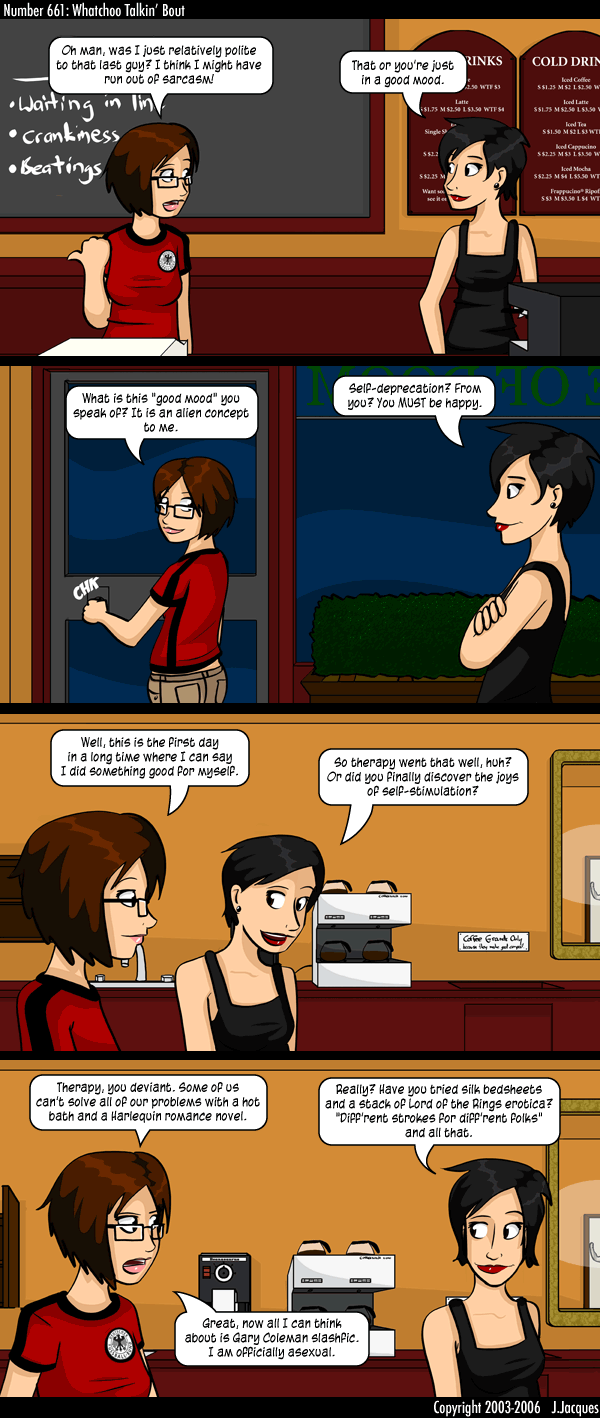
Thanks again to Mary for pointing this out. I always like to see the word "asexual" appear somewhere, although you'll have to wait until the last frame. Apologies for part of the image being cut off-- click on it and magnify to see the whole thing:


If I was offended by this, it would probably make for a much better post. But alas, I am not. You're looking at the web comic Questionable Content. By its very nature as a comic strip, it's not something most people are going to take seriously-- or look at for information on sexuality. Also, it implies that asexuality exists in some form, which is usually the hardest part of our battle. Sure, the strip implies that you can suddenly become asexual, which we all know isn't true. However, it's correct in stating that asexuality implies a lack of sexual desire, and it doesn't seem to be saying that there's anything wrong with being asexual. "I am officially asexual, and being part of that bizarre, pervy lot has scarred me for life"-- now that would offend me. So folks, what do you think; questionable, or not so much?