I went to see the play Vigil last weekend and was surprised to find that it had an asexual character. I can't say I was a huge fan of the production, but hey, at least it yielded a blog post. The character, Kemp, isn't hard to identify, since he's one of two characters and has 95% of the lines. He said something like this: "My mother wanted me to be a homosexual, but I don't have a sexuality." He went on to talk about how he found sex repulsive and how while sex distracted others, it had no such effect on him. Kemp related, in my mind, to a recent Shakesville post. The post in question asked: "What are your favorite characters from music, literature, movies, etc. who express a healthy (i.e. consensual) sexuality with which you identify? (Note from Liss: Or lack thereof. That is, if you're asexual, are there characters with whose asexuality you identify?)"
And it made me think...while I can identify a bunch of characters I think are asexual, can I really identify with any of them? Do any of them engage in a "healthy" asexuality? And by this I don't mean lacking in illness, disability, or emotional issues (Good God, no). I mean, do they act in ways that, in real life, would better their situations as asexuals? Usually, the answer seems to be no, if not hell nooo.
In Vigil, I could only guess that Kemp's asexuality was intended to spring from his general unlikeability. He's so rude and unpleasant that it isn't surprising to learn that he has no friends whatsoever. In short, he's a total misanthrope, as are many asexual characters. Part of Vigil, I think, was to break down Kemp's wall and show that he can share non-sexual intimacy with another person. However, this prevailing trope seems totally contrary to most (of course, not all) real asexuals' experiences. It seems like a lot of asexuals really want to be close to other people. What we lack is not the initial desire, like Kemp, but the means to connect in a culture that may not favor the kind of relationships we want to have.
So I was trying to answer the Shakesville question, but I couldn't. I guess I would say my favorite asexual character is Withnail (yeah, him again), but I couldn't say I closely relate to him, and he definitely isn't healthy, what with his constant drinking and drug use. But unlike Kemp, he does care a lot about his friend "I" from the start. And the story seems to be more about trying to keep a friend than learning to experience platonic bonds in the first place. But it was almost like Withnail and "I" were a couple, and Withnail wouldn't be able to function by himself. And a similar thing happened in Vigil. Sure, Kemp learned to love, but it was unclear what would happen to him after he lost the one person he ever connected to. It's like the story was trying to solve an nonromantic problem through the model of "the couple". If I mention "community" will you feel like you've been hit over the head?
Friday, April 16, 2010


Saturday, April 10, 2010
Aces in Fiction: Animythical Tales
This is an exciting post, but first, a little background: Last year, I wrote about "unnamed" asexuals in fiction. The basic idea was that "... it's still realistic for an asexual person to have never met another ace, and to not know that there is a word describing their sexuality that is in use for other people. If writers want to be realistic, the unnamed asexual is much closer to the truth than the 'out' asexual." However, that's not always an easy description to write. I didn't expect to get an e-mail from a reader saying, "I wrote a book like that, and it just got published"! Would I want to read it? Uh, hells yeah!
Animythical Tales is the book, which is a collection of 10 short stories in the fantasy or speculative fiction genre. Its writer, Sarah Totton, who is ace, told me that "...most (but not all) of [the stories] deal with asexual characters or themes. I'm thinking that other asexuals would 'get' what I was talking about when I wrote those stories in ways that a sexual reader might not..." I actually don't think I've ever read a short story in fantasy before, and I was impressed by the amount of invention that had to be condensed into a few pages.
So speculative fiction I am far from familiar with, but asexual characters...yeah, I'm a nerd. There were two stories that had obviously asexual characters, Henry in "Bluecoat Jack" and Bellan in "The Bone Fisher's Apprentice". How is this described, you may ask? In the latter story, the Bone Fisher is able to glance into Bellan's dreams and see that "there was simply no desire of that type for men or women in this man at all. And yet he was neither innocent nor damaged (93)." I liked the Bone Fisher's response to this "unusual" man: "He did not understand Bellan, but he was intrigued enough to let him sleep, at least another night, perhaps longer, so that he could study him". Henry seemed more distressed about his asexuality: "You don't know what you are. If it even has a name" (55), he says, after recounting his frustrating experiences with both women and men. Usually, real-life asexuals tend to shout about how passionately we nonsexually love things, just so people don't get the wrong idea. These characters are a lot more enigmatic than that.
Up until now, I've read a few vaguely asexy novels-- what asexual hasn't? But now that I have 10 self-contained, ostensibly asexual stories in my hands, I notice patterns emerging. I'd had no idea how much, as a reader, I'd relied upon, and expected, sex and sexualized romance to move a story along. The first time I ever noticed this was while watching the HBO series "In Treatment". It was very slow and plotless at times (yeah, yeah, my kinda thing), so when I saw that two characters had a growing attraction to each other, I was practically yelling at the screen, "Just hook up already!".
Because as we've explored, sex and romance serve as shorthands. No matter how random a story is, sex acts as an anchor of sorts and makes you think something meaningful is occurring. Whoever made "In Treatment" knew that holding off on what we expected to see would keep us interested (okay, that and Gabriel Byrne's voice). Animythical Tales is similarly challenging. The characters don't act how you might expect them to, which I think is a good thing. Without some of the typical signposts, I never quite knew where the stories were headed, so I wanted to keep reading to find out.
Saturday, April 3, 2010
"No Sexual Attraction" must have been too long
Well, it's high time for me to post something, so I might as well share a photo of the most epic socks ever. I shared them on AVEN, but in case you have yet to experience their glory:
 They hail from Sock Dreams in Portland, and also come in orange if pink is not your thing. Obviously, they're pretty silly, but I think one reason I liked them so much is because when I'm out and about in my daily life, I rarely see anything that relates to asexuality (or my experience of it). When I do, it's usually something I have to interpret to death before it starts relating to me. Except, of course, for the moment when I found these socks, proudly exclaiming, for some unknown reason, "NO SEX"!
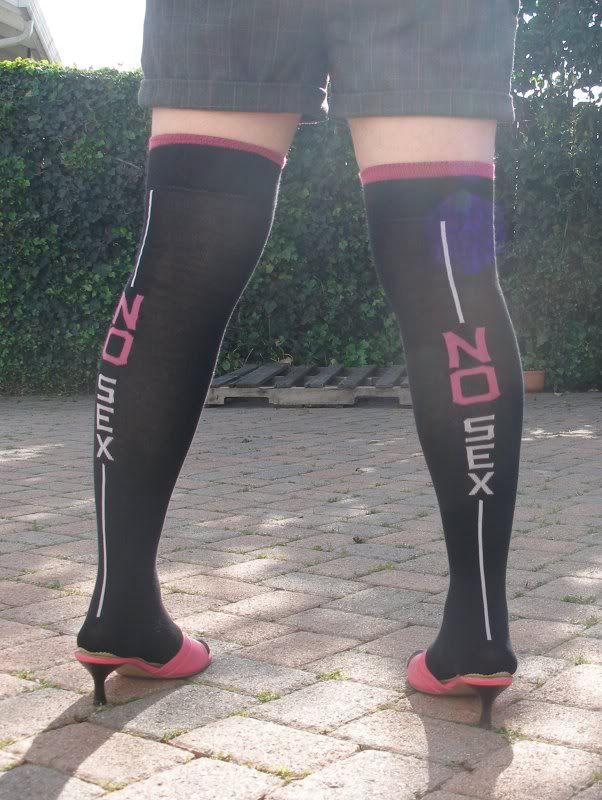 They hail from Sock Dreams in Portland, and also come in orange if pink is not your thing. Obviously, they're pretty silly, but I think one reason I liked them so much is because when I'm out and about in my daily life, I rarely see anything that relates to asexuality (or my experience of it). When I do, it's usually something I have to interpret to death before it starts relating to me. Except, of course, for the moment when I found these socks, proudly exclaiming, for some unknown reason, "NO SEX"!
Saturday, March 27, 2010
How Quickly They Forget
I've been coming out as asexual for a few years now, and one thing I've noticed is that people tend to forget that I've come out to them...or at least, it seems that way sometimes. It's hard to know if someone really forgot or if they just didn't process the information. Either way, I can't help but think: Asexuality is so unusual, why wouldn't it stick in someone's mind? And if I mentioned being gay or bi, would it seem to be so easily forgotten? (I doubt it.)
Thinking on this further, it occurs to me that maybe it just seems like people forget because no one really knows "what to do with" an asexual. People make all sorts of different attempts, and some come a lot further to how I'd like to be treated than others. My ideal is a middle ground between acting like I've never said I'm not heterosexual on the one hand and making a huge deal out of my orientation on the other. When someone in my life makes occasional references to asexuality in a neutral or positive way, that means a lot to me. As does making any effort to inform others about asexuality--It really warms my heart when people do that.
At a friend's house recently, I was reading this Miss Manners book. It occurred to me that one reason coming out is so scary is that there is no known etiquette attached to it. While I think the proper response is something along the lines of "I'm glad you told me" (to be followed by research on the orientation in question), this is in no way codified in our culture. Thinking about etiquette (which seems to have a lot to do with avoiding the discomfort of others) made me realize that the person you tell about asexuality might feel as awkward as you do. I think one major reason why people who are usually open-minded can be so dismissive of asexuality is that the existence of a whole sexual orientation they don't know about makes them self-conscious about their lack of knowledge. If asexuality doesn't exist, then they can still think they know everything. Few people let go of their assumptions easily.
That's just one reason why I remain such a proponent of "passive" coming-out methods--the letter, e-mail, or blog post, for example. In America, being a straight-shooter is often what we aim for. But it was comforting to read Miss Manners and see that sometimes being a bit evasive is exactly what "should" be done to maintain civility. I think we definitely need a guide about what to say, and what not to say (and why) when someone comes out as asexual. I wrote a little about it here, but I'm talking about an actual document. It could include ways to make it easier for the asexuals in a person's life to be open about their orientation, which I think is a big component in "how we'd like to be treated" after the coming-out is over. Obviously that will vary, but I think it would be great to be able to hand a pamphlet on those topics to our friends and family. What do you think would be in it?
Tuesday, March 23, 2010
The Lonely Crowd, Second Half
While I don't know if anyone's chomping at the bit to hear about the second part of The Lonely Crowd, it's sad to have, well, a lonely First Half without a Second Half. I'd recommend the book, although I think that you can stop reading in good conscience after the first section.
The Lonely Crowd has 3 parts: "Character", "Politics", and "Autonomy". While David Riesman captured my attention in "Character", he lost it in "Politics" and then had a hard time getting it back for "Autonomy". Autonomy is what you might expect-- a desirable state where you can form your own opinions, and in some way separate yourself from the dominant mode of conformity. Go figure that this is the shortest chapter-- Riesman admits that developing autonomy can be extremely difficult, and he only gives a few suggestions. Among these are making the workplace "less strenuous emotionally" (gee, does that sound familiar?), letting "avocational counselors" help us direct our leisure time, and letting children develop individualized interests by creating free "stores" for kids stocked with hobby materials. But my favorite suggestion of Riesman's is one to bring back utopian thinking. I believe that as children, we're all utopian thinkers. But somewhere along the way, a lot of us lose that ability. Riesman writes:
However, since we live in a time of disenchantment, such thinking, where it is rational in aim and method and not simply escapism, is not easy. It is easier to concentrate on programs for choosing among lesser evils...Both rich and poor avoid any goals, personal or social, that seem out of step with peer-group aspirations. (305)
Although the book, sadly, seems outdated in parts, the statement about "lesser evils" sounds like it could have been written today. Sometimes I try to visualize the world or life I want to see or have, but I tend to step back mentally because it's too overwhelming or seems impossible. Utopian thinking is intimidating, although if I allowed myself to do it more, maybe I'd be able to get a better idea of where in life I should put my efforts. Riesman would say I've been constrained by "other-direction" without even realizing it. Maybe it's important to know how and why we conform before we can start on the project of realizing our autonomy.
Wednesday, March 10, 2010
It All Connects Like Crazy
Cruising Netflix for something to watch on "Instant" view, I came across a TV series called Cashmere Mafia. Lasting only 7 episodes, it looked like some decently mindless entertainment. Watching the first episode, the show was so silly that I almost felt embarrassed, even though I was by myself. However, I got hooked and watched the whole series. Anyway, the show is very similar to Sex and the City, but it focuses much more on the protagonists' careers (they all went to business school together) and their struggles to balance high-powered careers and family. As silly as the show appears, I think it does verge on making some interesting statements about gender roles and women who are more successful at work than the men in their lives. If we can take a moment to admire one of the many awesome outfits of Lucy Liu:

(Her character, oddly, is named "Mia Mason", even though we see her parents in the show and they're both Chinese. She does have a short conversation with an Asian guy though, about why neither of them tend to date other Asians. Seemed topical.)
The show got me thinking (sounds like an oxymoron, but true) about how jobs are portrayed on TV. I realized that TV careers are not about the work, but almost totally about relationships. Even in shows like The Wire where the intricacies of police work are examined, office politics get just as much screen time as the work itself. It's also worth noting that virtually no one on TV is bad at their job, and job performance itself is never what causes problems. Everyone, it seems, would be able to do their job perfectly if it wasn't for issues of relationships getting in the way. This is all unbelievably relevant to The Lonely Crowd's description of an "other-directed" workplace. And for once, I think that TV might actually be reporting a real trend and concern in people's lives.
At least, it's a real trend (and major concern) in my own life. In the area where I live, most people seem overqualified for their jobs, which means that almost everyone can do the actual work required of them (and probably much more). I've never had a problem with the actual work in any job I've had, unless it was that the work was too boring and repetitive. What I did have a problem with was negotiating the constantly shifting relationships of the workplace. The characters in Cashmere Mafia seem to enjoy the challenge; I break down under it. One major reason my previous job tanked was my constant stress over office politics. That stress became so great that over time, I became unable to properly do my job. There is, theoretically, an upside-- increased recognition of your work, camaraderie, mentorship. But these seem to be in short supply, whereas the capacity for needless office drama seems to be endless.
So it's only natural that people would decide to make TV shows about it. I'm realizing that just like an aromantic or perpetually single person needs to figure out how to find the relationships they do want in a structure that doesn't cater to their needs, I need to find a career where my work will be rewarded, not, as David Riesman calls it, my "glad hand". Both of those things are extremely difficult in our culture as we know it. We know they exist, somewhere, but it's getting to them that's the hard part. Romantic relationships get a lot of play, but they're not the ones we might spend forty hours a week working on. Good lord, how it all connects like crazy...
(I'll be computerless for the next two weeks or so-- comment moderation will be pretty slow, but please don't let that stop you.)
Friday, March 5, 2010
Chivalry (and a few other things)
"This charming man..." --The Smiths
A lighter post, I hope--A few months ago, I tried to take the Eharmony.com test. I was curious if it would say I was unmatchable, because it seems like a lot of asexuals get that result. I got a few questions into the test and then gave up due to boredom. However, this hasn't stopped Eharmony from sending me periodic e-mails about dating tips. I do find them interesting to read. One was "Men-- 5 Simple Ways to Charm Your Date". I thought about the suggestions and whether or not, coming from a date, they would succeed in charming me:
1. Surprise your date with a CD of his or her favorite music.
Actually, this would probably charm me more than most other things, especially if the person took the time to make a mix...well, as long as they don't go around giving the same mix to every woman, that is...
2. Bring her one rose or a bouquet of tulips.
I'm not sure why this is even mentioned, since it's probably the least creative thing to give someone on a date.
3. Charm her with chocolate
I don't know why, but chocolate seems like a strange gift for the first few dates. And like flowers, it's pretty impersonal, unless you know you share a love of chocolate, or the topic of chocolate somehow came up.
4. Become the historian in your relationship.
Eharmony's description of this activity sounds like too much work for anyone, especially early on in the relationship when you may not be sure if you're in it for the long haul. But I'd be charmed if someone remembered anniversaries, even if they were silly ones. I do celebrate my AVENiversary, after all.
5. Be Chivalrous and gracious at all times.
Like a lot of people, I have mixed feelings about "chivalry". Personally, I'm a big fan of people being well-mannered, as I try (and sometimes fail) to be. But chivalry and etiquette are not the same. Most etiquette is gender-neutral. But chivalry is something that only flows from men to women. It has a clear history (that of medieval knights) but the meaning of its modern form is a muddled one. Can a show of chivalry really tell you where a guy stands on gender roles anymore? I kind of doubt it. Some say that chivalry died when women gained more equality, but I think this is just an unwarranted jab at feminism. A man can be supportive of traditional gender roles and at the same time, not be chivalrous at all.
And maybe I can only deal with potential chivalry from people without a sexual agenda. To me, chivalry with sexual overtones (from someone I am not attracted to) feels creepy and like the other person is just trying to run game. Same with flirting, as long as, again, I know I'm not attracted to the person in any way. I have a feeling a lot of non-asexuals might feel the same way about people they're not attracted to. For some people, chivalry is just an act and not a very convincing one. No, I'm definitely not going to be more likely to sleep with you if you pull out my chair for me.
Some wisdom on this topic comes from the dating advice of J.M. Kearns. He says, "...there is an issue that will send up quiet but important signals during your months of getting to know a new man [as a romantic prospect]. It has to do with how rigidly you each define masculinity and femininity. The two of you need to be equally flexible (or rigid) or there will be trouble" (emphasis his). I've never heard this idea explicitly mentioned anywhere else, but I think it's an extremely important one. I already feel the pressure to act "more feminine"; the last thing I'd need is even more of this pressure in a romantic relationship.
And lastly, thank goodness Sarah Haskins has targeted dating advice.
Subscribe to:
Posts (Atom)